
Understanding the Differences Between Western and Japanese Reiki
Reiki is a powerful healing practice that originated in Japan but has evolved in different ways across cultures. Suppose you’ve ever wondered about the key differences between Japanese Reiki (the original practice developed by Mikao Usui) and Western Reiki (the version that spread worldwide). In that case, this blog post will help you understand their unique characteristics.
1. Origins and Evolution
- Mikao Usui founded Japanese Reiki in the early 20th century and was deeply influenced by Japanese spiritual traditions, including Buddhism and Shinto. It was initially practiced as a personal growth and spiritual discipline, emphasizing meditation and self-awareness.
- Western Reiki was introduced to the world by Hawayo Takata, a Japanese-American woman who learned Reiki in Japan and adapted it for Western students. She simplified and structured the practice to make it more accessible, focusing on healing techniques rather than deep spiritual training.
2. Approach to Healing
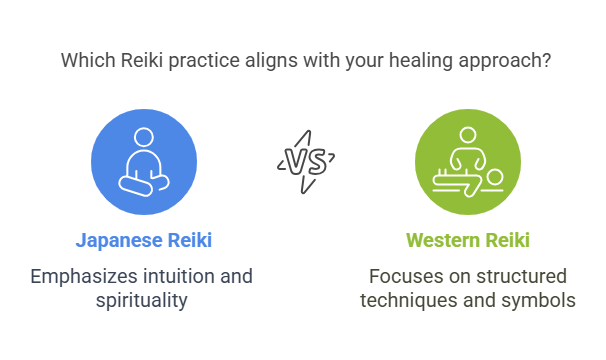
- Japanese Reiki emphasizes intuition. Practitioners use techniques like Byosen scanning, where they sense areas that need healing rather than following a set sequence of hand positions. The approach is fluid and personalized.
- Western Reiki follows a more structured method. Practitioners often use fixed hand positions and techniques that have been standardized for consistency in healing sessions.
3. Use of Symbols and Mantras
- Japanese Reiki does not emphasize symbols as much as Western Reiki. Symbols are seen as tools that help beginners connect with Reiki energy but are eventually meant to be transcended as one deepens their practice.
- Western Reiki places a strong emphasis on symbols and their corresponding mantras. Symbols are often introduced early in the training process, and their repeated use is considered essential for activating Reiki energy.
4. Spirituality and Meditation Practices
- Japanese Reiki integrates spiritual and meditative practices, such as Joshin Kokyu Ho (breathing meditation) and Reiju (spiritual blessings), which deepen the connection to Reiki energy.
- Western Reiki focuses more on energy healing as a technique rather than a spiritual discipline. While some teachers incorporate meditation, it is not always a primary focus.
5. Training and Attunements
- Japanese Reiki training is often informal and flexible, with an emphasis on ongoing personal practice. Attunements (called Reiju) are simple and viewed as a spiritual blessing rather than a formal initiation.
- Western Reiki is structured into certified courses (Reiki Level 1, 2, and Master), and attunements are performed as ritualized ceremonies that mark a student’s progression.
6. Influence of History and Culture
- Japanese Reiki remained mostly underground after World War II due to government restrictions on alternative healing practices in Japan. It survived mainly through oral transmission.
- Western Reiki flourished and adapted to fit various healing traditions. Over time, it has expanded into multiple branches such as Karuna Reiki, Holy Fire Reiki, and Rainbow Reiki.
Which One Is Right for You?
Both forms of Reiki are powerful and effective. If you’re drawn to a more intuitive, spiritual, and meditative approach, Japanese Reiki may resonate with you. If you prefer a structured, technique-focused healing method, Western Reiki could be the right fit.
Regardless of which path you choose, the heart of Reiki remains the same: a practice of healing, balance, and transformation.
My Personal Perspective
I sincerely appreciate both Western and Japanese Reiki, as each offers unique strengths and benefits. However, Japanese Reiki resonates with me much more because of its focus on personal development, intuition, and meditation. The deep spiritual practices and connection to self-awareness align with my journey, making it a truly transformative experience.
